Radicchio Pork Rolls

There are some ingredients that people just don’t like. For example radicchio. You can have it in small amounts in a salad, but a salad with only radicchio in it just won’t do. At least not for me. I was attracted to this recipe by it’s look and had to make it. During preparation, I tasted the filling for the rolls and got disgusted by it’s taste. I almost threw it in the trash. But, you don’t waste food these days so I went through the recipe and miraculously, after being wrapped in pork and fried in wine it tuned into one of the best pork dishes I’ve ever had. Who would have thought it would turn this way? :)

Radicchio Pork Rolls

(recipe is adapted from Sale & Pepe Magazine, Serbian issue for December 2009)

800 g lean pork (cut into a few slices and flattened for rolling)
1 onion
1-2 radicchios
40 g raisins
100 g smoked bacon, thinly sliced
a bundle of fresh flat leaf parsley
150-200 ml white wine
salt and pepper
olive oil for frying

Soak raisins into a bowl filled with water. In the meantime, finely chop the onion and sautee it on a splash of olive oil in a pan. Reserve a couple of large radicchio leaves, chop the rest into strips and add them into the pan with onion. If you don’t like the bitter taste of radicchio, don’t reserve anything. Add drained raisins to the pan and sautee everything on medium heat for about 10 minutes. Season to taste.

Take one slice of pork, arrange bacon strips on a working surface to create the shape and size similar to the meat and place meat over. Put some of the prepared raddicio over the meat, roll it and wrap tight with a kitchen rope. Repeat for the rest of the meat. Fry the rolls on all sides in the same pan you’ve sauteed radicchio. Pour wine over, wait until the alcohol evaporates and add coarsely chopped parsley. If you reserved some radicchio leaves, fry them along side with meat. And finally, prepare yourself to be amazed!

Note: This is my entry for Weekend Herb Blogging, hosted this week by Rachel from The Crispy Cook.

Categories: main course, Sale & Pepe
by

Strawberry Floating Islands

Info za čitaoce iz Srbije koji Palachinku prate na engleskom – na srpskoj verziji posta imate Remake i Mikser nagradnu igru :)

I wrote about Mezze magazine we started in the previous post. Now I have to tell you that it’s going great and that the girls and me will have a spot on a foodie event – Mikser Design Food. In the scope of this cooperation a joint project of Mezze and Remake design studio was born. You’ve seen their work on decorating a restaurant I wrote about – Gallo Nero. We from the Mezze team created our own remakes of a traditional recipes. I made my childhood favorite – Šnenokle (floating islands) in a Remake coffee cup :)

Strawberry Floating Islands

600 ml milk
4 + 1 Tbsp sugar
1 bag vanillin sugar
4 eggs
a pinch of salt
1 Tbsp flour
strawberry (or raspberry) puree

Reserve 100 ml milk for later. Beat the egg whites with 1 tablespoon sugar and a pinch of salt. Boil 500 ml milk, then reduce the temperature, start adding spoonfulls of beaten egg whites and cook them for about 10 – 20 seconds on each side. I served my floating islands in Remake coffee cups, so I made them teeny tiny, but if you serve them in a bowl or something, don’t bother with the small ones and make them using regular spoons. Place cooked islands in a fridge until you prepare the cream.

Beat the egg yolks with 4 tablespoons sugar, vanillin sugar and flour. Add reserved 100 ml milk. Strain the milk that you used for cooking the islands, return it into the pot and heat. In a thin stream, stirring continuously, start pouring the yolks mixture. Add a couple of tablespoons of strawberry puree, as much as you like, until you get the color and taste you like (I’ve put 6 tablespoons). Cook the cream until it thickens a bit.

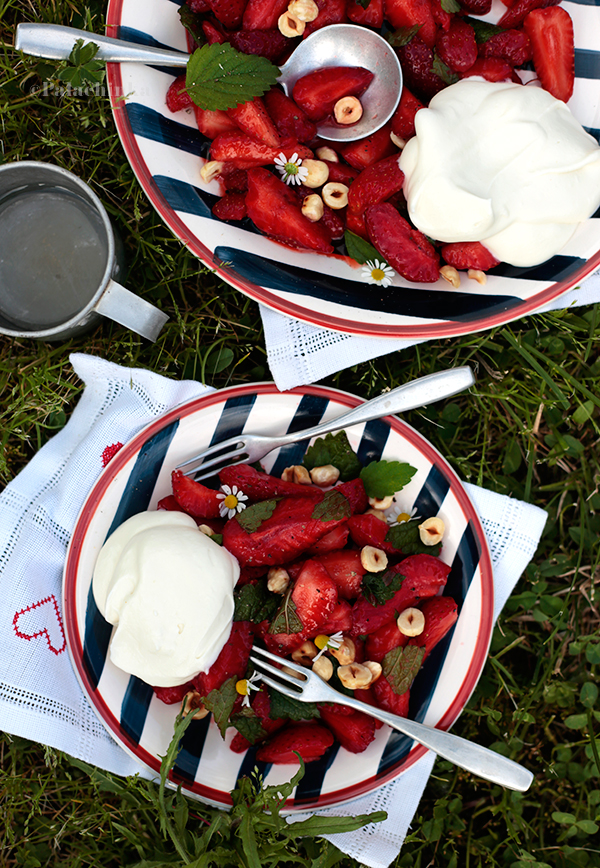
Serve chilled, with some fresh strawberries.

Note: The easiest way to prepare strawberry puree is to use frozen ones. When they’re thawed, they’ll get mushy. Put them into a pot and if you like, you can add some sugar to them and heat through. Puree in a blender and then transfer into a sieve. Using a pestle or anything handy press the mass through the sieve. This is not all that necessary, but this way you’ll get rid of the tiny seeds that might disturb the fine texture of the cream. Same thing goes for raspberries, but this time you’ll need to sieve them as their seeds are larger.

Categories: dessert, serbian food
by

Forrest Mushrooms

I wanna tell you about a new food bloggers from Serbia project. One day, over a cup of coffee, when a couple of us met, we realized that there is an initiative and will for a joint project. The idea has been cooking for a while but that day it was clear we could do it :)

We wanted to give the readers something different than they can usually find on the news stands. Not only a collection of recipes, but some reading material.

So, Mezze Magazine was born. The name comes from the Turkish word meaning appetizer, or a snack, that has been adopted for use in Serbia. Team consists of experienced food bloggers from Serbia: Mihaela, Olja, Lana, Jelena, Ana, Maja, Gaga, Sanja, Milica, Ivana and yours truly :)

The cute mushrooms above are made with quail eggs, cherry tomato and mayonnaise and can be made in a snap. For now, Mezze will only be in Serbian, but in some future, you can expect the translation :)

Mezze Magazine Front Page

Categories: appetizer, mezze, snack
by

Cream of pea, feta and basil soup

Last month has been very tumultuous for me. Some new projects are coming up and there will be some new travels in the next couple of months. But, all in due time, you will be updated as things happen :)

For now, I’ll try to make up for my absence from the blog as I’ve been cooking a lot and have a lot of new posts coming up.

Cream of pea, feta and basil soup

(original recipe)

2 Tbsp olive oil
1 onion, chopped
2 garlic cloves, pressed
450 g peas
1 potato, peeled and diced
1 l clear vegetable stock
1/2 tsp dried basil leaves
100 g feta cheese
salt and pepper to taste

Heat the olive oil in a pan, add the onions and garlic and cook until tender but not browned. Add a tablespoon or two water if needed, so they don’t burn. Add the peas and potato and stir. Pour the stock and bring to a boil. Cook covered on medium heat for about 15 minutes or until the potatoes and peas are cooked through.

Remove from the heat and add the basil leaves and stir. Leave the soup to cool a bit before pouring it into the blender. Puree everything with feta.

Heat the soup once again so that feta melts completely and season to taste.

Serve with croûtons and more grated feta on top.

Categories: soup
by

Restaurant Cantina de Frida

In our effort to write honest and realistic reviews of Belgrade restaurants, me and my friend Ana visited another Belgrade restaurant – Cantina de Frida. But, during our meal, we were harshly and rude asked to stop taking photos because there is only one photographer who is allowed to take photos inside this restaurant, so unfortunately, we are not able to share our review of this restaurant with you.

Talk about monopoly, ha?

Did you guys have similar experiences in restaurants? What do you think about this?

Categories: restaurants, serbia
by

Persian Roasted Chicken with Dried Cherry-Saffron Rice

Middle Eastern food is my new love. Food is warm and hearty and full of spices. If you make this recipe, you will know what I mean. Cumin and saffron and lots of butter :) I was kind of afraid of the amount of butter in the recipe, but the rice soaked up all of it and the taste was fantastic. The cherries were a pleasant surprise. I think that sugar made their sourness mild. I don’t know why don’t we use them more here. Cherries are one of the most used fruit in desserts here in Serbia, yet we never use them dried, only fresh and frozen. We use raisins a lot and I’m not such a fan of them. Can’t wait to try dried cherries in more recipes!

Persian Roasted Chicken with Dried Cherry-Saffron Rice

(adapted from here)

60 ml olive oil
1 onion, finely chopped
1 Tbsp lemon juice
1/2 tsp ground cumin
1/2 tsp saffron threads, crushed
1 kg chicken thighs and legs, with skin, on the bone
salt and freshly ground pepper
250 g basmati rice
150 g butter
100 g dried sour cherries
1 Tbsp sugar
30 g slivered almonds

Combine olive oil, onion, lemon juice, cumin and half of the saffron in a large bowl. Add the chicken, season with salt and pepper and coat well with the marinade. Let it stand at room temperature for about an hour.

Drain the chicken, scraping off the onion and saffron and transfer it to a large roasting pan. Add about 60 ml water, cover with aluminum foil and bake for 20 minutes in a preheated oven on 375°F/190°C. Uncover and bake for 25 minutes more.

While the chicken is roasting, fill a large saucepan with water, add salt and bring to a boil. Add the rice and cook for about 10 minutes. Drain the cooked rice. In a small bowl, dissolve the remaining saffron in 1 tablespoon of water. Put the rice into a bowl and stir in the saffron water.

Melt the butter with the dried sour cherries and sugar. Spoon one third of the rice into a buttered baking dish. Top with half of the sour cherries, butter and slivered almonds. Cover with half of the remaining rice and the remaining sour cherries, butter and almonds. Top with the last layer of rice and pour remaining butter on top, if there is any. Cover the dish with aluminum foil and bake for about 20 minutes (while the chicken is baking).

Preheat the broiler when the rice is done. Broil the chicken, skin side down, for 2 minutes. Turn the chicken and broil until the skin is browned and crisp, for about 3 minutes.

Categories: iranian food, main course
by

Banat Struedel

I can’t tell you much about this struedel. I know it’s made in Banat region of Serbia, but except that, not much more :) What I can tell you, even though this wasn’t what I expected and the dough looks very different than in the photo of the original recipe, is that it is great for this time of year and goes wonderfully with a glass of milk.

Banat Struedel

(original recipe)

Dough

300 g fluor
15 g fresh yeast
1 Tbsp sugar
1/2 Tbsp salt
1/2 egg
1/2 egg yolk
2 1/2 Tbsp sunflower oil
50 ml milk
80 ml water

Filling

2 Tbsp pork fat
2 Tbsp sugar
1 tsp lemon juice
1 1/2 egg yolk
100 g raisins

Dissolve yeast in lukewarm milk with sugar and let it rest until it doubles in volume.

In a bowl mix all the ingredients for the dough, add yeast and knead elastic, smooth dough. Let it proof until doubled in volume, knead again and let proof once more. Flatten on a floured working surface into a rectangular shape.

In a small bowl mix the ingredients for filling (except raisins) and spread over the flattened dough. Toss the raisins over and roll. Take roll on each end and twist like a spiral.

Bake in a preheated oven on 200°C about 30 minutes. Serve dusted with lots of powdered sugar. Most of the filling leaked out of the struedel during baking leaving a charcoal piece next to the struedel. There is not much you can do about it. I made this twice and happened both times.

Note: I am sending this to Susan for YeastSpotting.

Categories: dessert, serbian food
by

Gallo Nero, menu

I am proud that finally, I am able to present you a Belgrade restaurant worth recommending. Following up are my impressions, and what Ana, my partner in crime thought you can read here.

Colorful plates, polka dots, vintage furniture, figurines… Combination of a simple concept of the owner and head chef Alessandro Daví, relaxed atmosphere and amazing interior in a shubby chic style created by Remake duo will leave you breathless.

Gallo Nero, interior

Osteria Gallo Nero is a place to eat simple, traditional pasta, prepared honestly, straight from the heart.

Gallo Nero, menu

The menu has only a few fixed dishes and the rest are prepared each day differently, depending on the mood of the chef. And please, do check out the lovely menu with the post-its :)

Gallo Nero, antipasto

The first dish we had was Antipasto della casa. Prosciutto, anchovies, dried tomatoes, mozzarella, fresh tomatoes, arugula and bruschetta, and everything served with balsamic reduction. The most beautiful antipasto plate I’ve ever seen!

Gallo Nero, antipasto

You either love or hate anchovies. I just love them so this was perfect. Bruschetta was prepared on a perfectly round slices of bread, with cheese, olives and capers. One portion serves two and if you’re not too hungry, this, with a few more bruschetta, will be enough.

The interesting part is the price – 5,5 euro. A bargain for a plate like this in Belgrade.

Gallo Nero, interior

Whole pasta is freshly made for the day. And you can tell the difference.

Pasta pollo, noci e broccoli

The first one we had was Pasta pollo, noci e broccoli – chicken, cream, walnuts, broccoli and Parmesan cheese. Light, mild and huge portion.

Pasta pollo, noci e broccoli

Gallo Nero often has dishes on discount. The day we went, all the pasta was about 3,8 euro (regular price of this dish is 5,5 euro). Not much places in Belgrade worth mentioning that can compete with those prices.

Gallo Nero, napkins

One of the things that thrilled me, and what I read in one of the interviews Alesandro gave was the care when selecting the ingredients. When they asked him why there’s no cannoli on the menu, he said there’s no good ricotta in Serbia. Imagine if all the cooks chose the ingredients this way :)

Maiale piccante con peperoni

The next pasta was Maiale piccante con peperoni – tomatoes, pork shoulder, wine, peperoncini, red and yellow bell pepper, onion, carrots and Parmesan cheese. A plate full of color and taste that compliments the interior. It was hot just as much as needed and again it was a huge potion.

Maiale piccante con peperoni

Some might think arugula everywhere, but I found it nice.

Regular price of this dish is 6,5 euro.

Pann caffe

We only had one dessert as we were already full bu the time for it. Pann caffe is a variation to the tiramisu theme, with ladyfingers soaked in coffee, yellow cream made with yolks and whipped cream.

Gallo Nero, interior

After all those beautifully presented dishes this seemed a little poor, but as far as the taste it was perfect. Not a great fan of sweet things, I found this light dessert very good. Price is 2,8 euro.

Pann caffe

Final impression: This is a place to come back often. Personally, I am very difficult when it comes to eating out. Most of the time I go away disappointed. Thinking I could have made it better at home and feel sorry for the money spent. I always complain – on food, interior and service. Here everything is different. Everything is perfect. And it seems to me that whatever I write, the picture I painted for you isn’t worth what this place offers. I think the best thing to say is if you ever come to Belgrade, come to the Black Rooster and you will not be disappointed :)

Osteria Gallo Nero
Kneginje Ljubice 26
Belgrade, Serbia

+381113031434
+381637044079

Categories: italian food, restaurants
by

Homemade Cream Cheese

Homemade Cream Cheese

(original recipe)

2 l milk (2,8% milk fat)
360 g Bulgarian buttermilk* (3,2% milk fat)

Boil milk. Let it get lukewarm and stir in buttermilk. Cover the pot and wrap it in a blanket. Keep like that overnight in a warm place to ferment. It will become curdled during the process.

In the morning, line a large sieve with large cheese cloth or any other fabric with similar texture. I, for example, use either kitchen cloth or a cloth diaper :) Pour curdled milk into the lined sieve and then wrap it like a sack and tie with a rope. Hang it to drain and put a large bowl under it to collect the draining whey. Jelena says that this whey can be used instead of water when making bread. I still haven’t tried it but intend to.

You could let it drain without having to tie it, but it will take longer (5-8 hours) and whenever I make homemade cheese, I use this traditional method to hang it to drain and it takes about one to one and a half hour.

There is no need to add any more salt because this type of buttermilk is already salted, but then, again, you should taste it and season if you wish.

Makes about 500 g cream cheese.

Homemade Cream Cheese

*What we have in Serbia is called soured milk. It is fermented milk product made by using Lactobacillus delbrueckii subsp. bulgaricus. I am not 100% sure if it is exactly the same as Bulgarian buttermilk, but I suppose that cultured milk product made using this bacteria will produce the same taste in cheese. Just make sure that you use products with proper amount of milk fat.

Categories: appetizer, cheese
by